
Networks Using Blocks (VGG)
While AlexNet offered empirical evidence that deep CNNs can achieve good results, it did not provide a general template to guide subsequent researchers in designing new networks. In the following sections, we will introduce several heuristic concepts commonly used to design deep networks.
Progress in this field mirrors that of VLSI (very large scale integration) in chip design where engineers moved from placing transistors to logical elements to logic blocks [120]. Similarly, the design of neural network architectures has grown progressively more abstract, with researchers moving from thinking in terms of individual neurons to whole layers, and now to blocks, repeating patterns of layers. A decade later, this has now progressed to researchers using entire trained models to repurpose them for different, albeit related, tasks. Such large pretrained models are typically called foundation models [121].
Back to network design. The idea of using blocks first emerged from the Visual Geometry Group (VGG) at Oxford University, in their eponymously-named VGG network [91]. It is easy to implement these repeated structures in code with any modern deep learning framework by using loops and subroutines.
using Pkg; Pkg.activate("../../d2lai")
using d2lai
using Flux
using CUDA, cuDNN
Activating project at `/workspace/d2l-julia/d2lai`[ Info: Precompiling d2lai [749b8817-cd67-416c-8a57-830ea19f3cc4] (cache misses: include_dependency fsize change (2))
(VGG Blocks)
The basic building block of CNNs is a sequence of the following: (i) a convolutional layer with padding to maintain the resolution, (ii) a nonlinearity such as a ReLU, (iii) a pooling layer such as max-pooling to reduce the resolution. One of the problems with this approach is that the spatial resolution decreases quite rapidly. In particular, this imposes a hard limit of
The key idea of Simonyan and Zisserman [91] was to use multiple convolutions in between downsampling via max-pooling in the form of a block. They were primarily interested in whether deep or wide networks perform better. For instance, the successive application of two
Back to VGG: a VGG block consists of a sequence of convolutions with vgg_block to implement one VGG block.
The function below takes two arguments, corresponding to the number of convolutional layers num_convs and the number of output channels num_channels.
struct VGGBlock{N} <: AbstractModel
    net::N
end

function VGGBlock(num_convs, in_channels, out_channels, conv_size = 3)
    layers = map(1:num_convs) do i
        if i == 1
            return Conv((conv_size,conv_size), in_channels => out_channels, relu, pad = 1)
        else
            return Conv((conv_size,conv_size), out_channels => out_channels, relu, pad = 1)
        end
    end
    net = Chain(layers...,
        MaxPool((2,2), stride = 2),
    )
    VGGBlock(net)
end

Flux.@layer VGGBlock

(v::VGGBlock)(x) = v.net(x)[VGG Network]
Like AlexNet and LeNet, the VGG Network can be partitioned into two parts: the first consisting mostly of convolutional and pooling layers and the second consisting of fully connected layers that are identical to those in AlexNet. The key difference is that the convolutional layers are grouped in nonlinear transformations that leave the dimensonality unchanged, followed by a resolution-reduction step, as depicted in Figure.
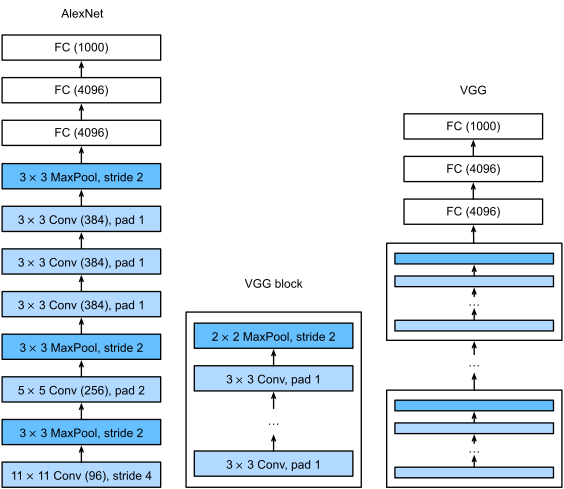 :width:
400px 🏷️fig_vgg
The convolutional part of the network connects several VGG blocks from Figure (also defined in the vgg_block function) in succession. This grouping of convolutions is a pattern that has remained almost unchanged over the past decade, although the specific choice of operations has undergone considerable modifications. The variable arch consists of a list of tuples (one per block), where each contains two values: the number of convolutional layers and the number of output channels, which are precisely the arguments required to call the vgg_block function. As such, VGG defines a family of networks rather than just a specific manifestation. To build a specific network we simply iterate over arch to compose the blocks.
struct VGGNet{N} <: AbstractClassifier
    net::N
end

function VGGNet(arch::Tuple, num_classes = 10)
    out_channels = getindex.(arch, 2)
    in_channels = (1, out_channels[1:end-1]...)
    num_convs = getindex.(arch, 1)
    blocks = map(num_convs, out_channels, in_channels) do n_conv, out_ch, in_ch
        VGGBlock(n_conv, in_ch, out_ch)
    end
    net = Flux.@autosize (224, 224, 1, 1) Chain(
        blocks...,
        Flux.flatten,
        Dense(_ => 4096, relu),
        Dropout(0.5),
        Dense(4096 => 4096, relu),
        Dropout(0.5),
        Dense(4096 => num_classes),
        softmax,
    )
    VGGNet(net)
end

Flux.@layer VGGNet

(vnet::VGGNet)(x) = vnet.net(x)
The original VGG network had five convolutional blocks, among which the first two have one convolutional layer each and the latter three contain two convolutional layers each. The first block has 64 output channels and each subsequent block doubles the number of output channels, until that number reaches 512. Since this network uses eight convolutional layers and three fully connected layers, it is often called VGG-11.
VGGNet(((1, 64), (1, 128), (2, 256), (2, 512), (2, 512)))VGGNet(
Chain(
VGGBlock(
Chain(
Conv((3, 3), 1 => 64, relu, pad=1), # 640 parameters
MaxPool((2, 2)),
),
),
VGGBlock(
Chain(
Conv((3, 3), 64 => 128, relu, pad=1), # 73_856 parameters
MaxPool((2, 2)),
),
),
VGGBlock(
Chain(
Conv((3, 3), 128 => 256, relu, pad=1), # 295_168 parameters
Conv((3, 3), 256 => 256, relu, pad=1), # 590_080 parameters
MaxPool((2, 2)),
),
),
VGGBlock(
Chain(
Conv((3, 3), 256 => 512, relu, pad=1), # 1_180_160 parameters
Conv((3, 3), 512 => 512, relu, pad=1), # 2_359_808 parameters
MaxPool((2, 2)),
),
),
VGGBlock(
Chain(
Conv((3, 3), 512 => 512, relu, pad=1), # 2_359_808 parameters
Conv((3, 3), 512 => 512, relu, pad=1), # 2_359_808 parameters
MaxPool((2, 2)),
),
),
Flux.flatten,
Dense(25088 => 4096, relu), # 102_764_544 parameters
Dropout(0.5),
Dense(4096 => 4096, relu), # 16_781_312 parameters
Dropout(0.5),
Dense(4096 => 10), # 40_970 parameters
NNlib.softmax,
),
) # Total: 22 arrays, 128_806_154 parameters, 491.359 MiB.As you can see, we halve height and width at each block, finally reaching a height and width of 7 before flattening the representations for processing by the fully connected part of the network. Simonyan and Zisserman (2014) described several other variants of VGG. In fact, it has become the norm to propose families of networks with different speed–accuracy trade-off when introducing a new architecture.
Training
Since VGG-11 is computationally more demanding than AlexNet we construct a network with a smaller number of channels. This is more than sufficient for training on Fashion-MNIST. The model training process is similar to that of AlexNet in :numref:sec_alexnet. Again observe the close match between validation and training loss, suggesting only a small amount of overfitting.
model = VGGNet(((1, 16), (1, 32), (2, 64), (2, 128), (2, 128)))
data = d2lai.FashionMNISTData(batchsize = 128, resize = (224, 224))
opt = Descent(0.01)
trainer = Trainer(model, data, opt; max_epochs = 10, gpu = true, board_yscale = :identity)
d2lai.fit(trainer);
[ Info: Train Loss: 0.48188314, Val Loss: 0.3698047, Val Acc: 0.875
[ Info: Train Loss: 0.5084389, Val Loss: 0.25148895, Val Acc: 0.875
[ Info: Train Loss: 0.2939905, Val Loss: 0.26616976, Val Acc: 0.875
[ Info: Train Loss: 0.3377501, Val Loss: 0.21927431, Val Acc: 0.875
[ Info: Train Loss: 0.22468491, Val Loss: 0.18230689, Val Acc: 0.9375
[ Info: Train Loss: 0.34149575, Val Loss: 0.17228371, Val Acc: 0.9375
[ Info: Train Loss: 0.32494318, Val Loss: 0.15211411, Val Acc: 0.9375
[ Info: Train Loss: 0.33381274, Val Loss: 0.15485266, Val Acc: 0.9375
[ Info: Train Loss: 0.27774346, Val Loss: 0.13706203, Val Acc: 0.875
[ Info: Train Loss: 0.31419504, Val Loss: 0.14435501, Val Acc: 1.0(VGGNet{Chain{Tuple{VGGBlock{Chain{Tuple{Conv{2, 4, typeof(relu), Array{Float32, 4}, Vector{Float32}}, MaxPool{2, 4}}}}, VGGBlock{Chain{Tuple{Conv{2, 4, typeof(relu), Array{Float32, 4}, Vector{Float32}}, MaxPool{2, 4}}}}, VGGBlock{Chain{Tuple{Conv{2, 4, typeof(relu), Array{Float32, 4}, Vector{Float32}}, Conv{2, 4, typeof(relu), Array{Float32, 4}, Vector{Float32}}, MaxPool{2, 4}}}}, VGGBlock{Chain{Tuple{Conv{2, 4, typeof(relu), Array{Float32, 4}, Vector{Float32}}, Conv{2, 4, typeof(relu), Array{Float32, 4}, Vector{Float32}}, MaxPool{2, 4}}}}, VGGBlock{Chain{Tuple{Conv{2, 4, typeof(relu), Array{Float32, 4}, Vector{Float32}}, Conv{2, 4, typeof(relu), Array{Float32, 4}, Vector{Float32}}, MaxPool{2, 4}}}}, typeof(Flux.flatten), Dense{typeof(relu), Matrix{Float32}, Vector{Float32}}, Dropout{Float64, Colon, Random.TaskLocalRNG}, Dense{typeof(relu), Matrix{Float32}, Vector{Float32}}, Dropout{Float64, Colon, Random.TaskLocalRNG}, Dense{typeof(identity), Matrix{Float32}, Vector{Float32}}, typeof(softmax)}}}(Chain(VGGBlock{Chain{Tuple{Conv{2, 4, typeof(relu), Array{Float32, 4}, Vector{Float32}}, MaxPool{2, 4}}}}(Chain(Conv((3, 3), 1 => 16, relu, pad=1), MaxPool((2, 2)))), VGGBlock{Chain{Tuple{Conv{2, 4, typeof(relu), Array{Float32, 4}, Vector{Float32}}, MaxPool{2, 4}}}}(Chain(Conv((3, 3), 16 => 32, relu, pad=1), MaxPool((2, 2)))), VGGBlock{Chain{Tuple{Conv{2, 4, typeof(relu), Array{Float32, 4}, Vector{Float32}}, Conv{2, 4, typeof(relu), Array{Float32, 4}, Vector{Float32}}, MaxPool{2, 4}}}}(Chain(Conv((3, 3), 32 => 64, relu, pad=1), Conv((3, 3), 64 => 64, relu, pad=1), MaxPool((2, 2)))), VGGBlock{Chain{Tuple{Conv{2, 4, typeof(relu), Array{Float32, 4}, Vector{Float32}}, Conv{2, 4, typeof(relu), Array{Float32, 4}, Vector{Float32}}, MaxPool{2, 4}}}}(Chain(Conv((3, 3), 64 => 128, relu, pad=1), Conv((3, 3), 128 => 128, relu, pad=1), MaxPool((2, 2)))), VGGBlock{Chain{Tuple{Conv{2, 4, typeof(relu), Array{Float32, 4}, Vector{Float32}}, Conv{2, 4, typeof(relu), Array{Float32, 4}, Vector{Float32}}, MaxPool{2, 4}}}}(Chain(Conv((3, 3), 128 => 128, relu, pad=1), Conv((3, 3), 128 => 128, relu, pad=1), MaxPool((2, 2)))), flatten, Dense(6272 => 4096, relu), Dropout(0.5), Dense(4096 => 4096, relu), Dropout(0.5), Dense(4096 => 10), softmax)), (val_loss = Float32[0.30930406, 0.27966642, 0.24678184, 0.2963435, 0.3039956, 0.3340265, 0.26703936, 0.34077984, 0.2760143, 0.3184268 … 0.3769835, 0.21881735, 0.32038057, 0.33395818, 0.21082029, 0.36042413, 0.24314894, 0.18392721, 0.3268779, 0.14435501], val_acc = [0.8828125, 0.8984375, 0.8984375, 0.8984375, 0.8984375, 0.9140625, 0.9296875, 0.875, 0.90625, 0.875 … 0.8671875, 0.90625, 0.8671875, 0.875, 0.90625, 0.8828125, 0.8828125, 0.9375, 0.8671875, 1.0]))Summary
One might argue that VGG is the first truly modern convolutional neural network. While AlexNet introduced many of the components of what make deep learning effective at scale, it is VGG that arguably introduced key properties such as blocks of multiple convolutions and a preference for deep and narrow networks. It is also the first network that is actually an entire family of similarly parametrized models, giving the practitioner ample trade-off between complexity and speed. This is also the place where modern deep learning frameworks shine. It is no longer necessary to generate XML configuration files to specify a network but rather, to assemble said networks through simple Python code.
More recently ParNet [123] demonstrated that it is possible to achieve competitive performance using a much more shallow architecture through a large number of parallel computations. This is an exciting development and there is hope that it will influence architecture designs in the future. For the remainder of the chapter, though, we will follow the path of scientific progress over the past decade.
Exercises
Compared with AlexNet, VGG is much slower in terms of computation, and it also needs more GPU memory.
Compare the number of parameters needed for AlexNet and VGG.
Compare the number of floating point operations used in the convolutional layers and in the fully connected layers.
How could you reduce the computational cost created by the fully connected layers?
When displaying the dimensions associated with the various layers of the network, we only see the information associated with eight blocks (plus some auxiliary transforms), even though the network has 11 layers. Where did the remaining three layers go?
Use Table 1 in the VGG paper [91] to construct other common models, such as VGG-16 or VGG-19.
Upsampling the resolution in Fashion-MNIST eight-fold from
to dimensions is very wasteful. Try modifying the network architecture and resolution conversion, e.g., to 56 or to 84 dimensions for its input instead. Can you do so without reducing the accuracy of the network? Consult the VGG paper [91] for ideas on adding more nonlinearities prior to downsampling.
1: A: The parameters needed for AlexNet is 46_764_746 and for VGG-11 is 128_806_154, almost thrice to that of an AlexNet C: We can use pooling to downsample more towards the end.
2: Not an issue in Julia. However for Pytorch, the display shows the output of a sequential layer, i.e. collected output for all convolution layers + the pooling layer associated to a block, thats why we see less layers.
3: VGG 16 and VGG 19 Respectively:
vgg_16 = VGGNet(((2, 64), (2, 128), (3, 256), (3, 512), (3, 512)))VGGNet(
Chain(
VGGBlock(
Chain(
Conv((3, 3), 1 => 64, relu, pad=1), # 640 parameters
Conv((3, 3), 64 => 64, relu, pad=1), # 36_928 parameters
MaxPool((2, 2)),
),
),
VGGBlock(
Chain(
Conv((3, 3), 64 => 128, relu, pad=1), # 73_856 parameters
Conv((3, 3), 128 => 128, relu, pad=1), # 147_584 parameters
MaxPool((2, 2)),
),
),
VGGBlock(
Chain(
Conv((3, 3), 128 => 256, relu, pad=1), # 295_168 parameters
Conv((3, 3), 256 => 256, relu, pad=1), # 590_080 parameters
Conv((3, 3), 256 => 256, relu, pad=1), # 590_080 parameters
MaxPool((2, 2)),
),
),
VGGBlock(
Chain(
Conv((3, 3), 256 => 512, relu, pad=1), # 1_180_160 parameters
Conv((3, 3), 512 => 512, relu, pad=1), # 2_359_808 parameters
Conv((3, 3), 512 => 512, relu, pad=1), # 2_359_808 parameters
MaxPool((2, 2)),
),
),
VGGBlock(
Chain(
Conv((3, 3), 512 => 512, relu, pad=1), # 2_359_808 parameters
Conv((3, 3), 512 => 512, relu, pad=1), # 2_359_808 parameters
Conv((3, 3), 512 => 512, relu, pad=1), # 2_359_808 parameters
MaxPool((2, 2)),
),
),
Flux.flatten,
Dense(25088 => 4096, relu), # 102_764_544 parameters
Dropout(0.5),
Dense(4096 => 4096, relu), # 16_781_312 parameters
Dropout(0.5),
Dense(4096 => 10), # 40_970 parameters
NNlib.softmax,
),
) # Total: 32 arrays, 134_300_362 parameters, 512.318 MiB.vgg_19 = VGGNet(((2, 64), (2, 128), (4, 256), (4, 512), (4, 512)))VGGNet(
Chain(
VGGBlock(
Chain(
Conv((3, 3), 1 => 64, relu, pad=1), # 640 parameters
Conv((3, 3), 64 => 64, relu, pad=1), # 36_928 parameters
MaxPool((2, 2)),
),
),
VGGBlock(
Chain(
Conv((3, 3), 64 => 128, relu, pad=1), # 73_856 parameters
Conv((3, 3), 128 => 128, relu, pad=1), # 147_584 parameters
MaxPool((2, 2)),
),
),
VGGBlock(
Chain(
Conv((3, 3), 128 => 256, relu, pad=1), # 295_168 parameters
Conv((3, 3), 256 => 256, relu, pad=1), # 590_080 parameters
Conv((3, 3), 256 => 256, relu, pad=1), # 590_080 parameters
Conv((3, 3), 256 => 256, relu, pad=1), # 590_080 parameters
MaxPool((2, 2)),
),
),
VGGBlock(
Chain(
Conv((3, 3), 256 => 512, relu, pad=1), # 1_180_160 parameters
Conv((3, 3), 512 => 512, relu, pad=1), # 2_359_808 parameters
Conv((3, 3), 512 => 512, relu, pad=1), # 2_359_808 parameters
Conv((3, 3), 512 => 512, relu, pad=1), # 2_359_808 parameters
MaxPool((2, 2)),
),
),
VGGBlock(
Chain(
Conv((3, 3), 512 => 512, relu, pad=1), # 2_359_808 parameters
Conv((3, 3), 512 => 512, relu, pad=1), # 2_359_808 parameters
Conv((3, 3), 512 => 512, relu, pad=1), # 2_359_808 parameters
Conv((3, 3), 512 => 512, relu, pad=1), # 2_359_808 parameters
MaxPool((2, 2)),
),
),
Flux.flatten,
Dense(25088 => 4096, relu), # 102_764_544 parameters
Dropout(0.5),
Dense(4096 => 4096, relu), # 16_781_312 parameters
Dropout(0.5),
Dense(4096 => 10), # 40_970 parameters
NNlib.softmax,
),
) # Total: 38 arrays, 139_610_058 parameters, 532.574 MiB.4:
struct VGGSmallNet{N} <: AbstractClassifier
    net::N
end

function VGGSmallNet(; num_classes = 10)
    net = Flux.@autosize (56, 56, 1, 1) Chain(
        Conv((3,3), 1 => 16, relu, pad = 1),
        MaxPool((2,2), stride = 2),

        Conv((3,3), 16 => 32, relu, pad = 1),
        MaxPool((2,2), stride = 2),

        Conv((3,3), 32 => 64, relu, pad = 1),
        Conv((1,1), 64 => 64, relu),
        MaxPool((2,2), stride = 1),

        Conv((3,3), 64 => 128, relu, pad = 1),
        Conv((1,1), 128 => 128, relu),
        MaxPool((2,2), stride = 2),


        Flux.flatten,
        Dense(_ => 4096, relu),
        Dropout(0.5),
        Dense(4096, 4096, relu),
        Dropout(0.5),
        Dense(4096, num_classes),
        softmax


    )
    VGGSmallNet(net)
end
Flux.@layer VGGSmallNet
(v::VGGSmallNet)(x) = v.net(x)data_downsampled = d2lai.FashionMNISTData(batchsize = 128, resize = (56, 56))
model_small = VGGSmallNet()
opt = Descent(0.01)
trainer_small = Trainer(model_small, data_downsampled, opt; max_epochs = 10, gpu = true, board_yscale = :identity)
d2lai.fit(trainer_small); [ Info: Train Loss: 0.95945525, Val Loss: 0.5622649, Val Acc: 0.8125
[ Info: Train Loss: 0.56179816, Val Loss: 0.40773425, Val Acc: 0.875
[ Info: Train Loss: 0.5326469, Val Loss: 0.33665746, Val Acc: 0.8125
[ Info: Train Loss: 0.47002974, Val Loss: 0.24386045, Val Acc: 0.875
[ Info: Train Loss: 0.34498596, Val Loss: 0.2215715, Val Acc: 0.9375
[ Info: Train Loss: 0.51154643, Val Loss: 0.28165364, Val Acc: 0.875
[ Info: Train Loss: 0.25447252, Val Loss: 0.24042852, Val Acc: 0.875
[ Info: Train Loss: 0.40097007, Val Loss: 0.17593385, Val Acc: 0.9375
[ Info: Train Loss: 0.22108968, Val Loss: 0.22856621, Val Acc: 0.875
[ Info: Train Loss: 0.20709628, Val Loss: 0.19818446, Val Acc: 0.875