
Multi-Branch Networks (GoogLeNet)
In 2014, GoogLeNet won the ImageNet Challenge [92], using a structure that combined the strengths of NiN [78], repeated blocks [91], and a cocktail of convolution kernels. It was arguably also the first network that exhibited a clear distinction among the stem (data ingest), body (data processing), and head (prediction) in a CNN. This design pattern has persisted ever since in the design of deep networks: the stem is given by the first two or three convolutions that operate on the image. They extract low-level features from the underlying images. This is followed by a body of convolutional blocks. Finally, the head maps the features obtained so far to the required classification, segmentation, detection, or tracking problem at hand.
The key contribution in GoogLeNet was the design of the network body. It solved the problem of selecting convolution kernels in an ingenious way. While other works tried to identify which convolution, ranging from
using Pkg; Pkg.activate("../../d2lai")
using d2lai
using Flux
using CUDA, cuDNN
Activating project at `/workspace/d2l-julia/d2lai`Inception Blocks
The basic convolutional block in GoogLeNet is called an Inception block, stemming from the meme "we need to go deeper" from the movie Inception. 
Structure of the Inception block.
As depicted in Figure, the inception block consists of four parallel branches. The first three branches use convolutional layers with window sizes of
struct InceptionBlock{N1, N2, N3, N4} <: AbstractModel
    net1::N1
    net2::N2
    net3::N3
    net4::N4
end

function InceptionBlock(channel_in::Int, channel1::Int, channel2::Tuple, channel3::Tuple, channel4::Int)
    net1 = Chain(
        Conv((1,1), channel_in => channel1, relu)
    )

    net2 = Chain(
        Conv((1,1), channel_in => channel2[1], relu),
        Conv((3,3), channel2[1] => channel2[2], relu, pad = 1)
    )

    net3 = Chain(
        Conv((1,1), channel_in => channel3[1], relu),
        Conv((5,5), channel3[1] => channel3[2], relu, pad = 2)
    )

    net4 = Chain(
        MaxPool((3,3), pad = 1, stride = 1),
        Conv((1,1), channel_in => channel4)
    )
    InceptionBlock(net1, net2, net3, net4)
end

function (ib::InceptionBlock)(x)
    n1 = ib.net1(x)
    n2 = ib.net2(x)
    n3 = ib.net3(x)
    n4 = ib.net4(x)
    cat(n1, n2, n3, n4; dims = 3)
end

Flux.@layer InceptionBlock
To gain some intuition for why this network works so well, consider the combination of the filters. They explore the image in a variety of filter sizes. This means that details at different extents can be recognized efficiently by filters of different sizes. At the same time, we can allocate different amounts of parameters for different filters.
GoogLeNet Model
As shown in Figure, GoogLeNet uses a stack of a total of 9 inception blocks, arranged into three groups with max-pooling in between, and global average pooling in its head to generate its estimates. Max-pooling between inception blocks reduces the dimensionality. At its stem, the first module is similar to AlexNet and LeNet. 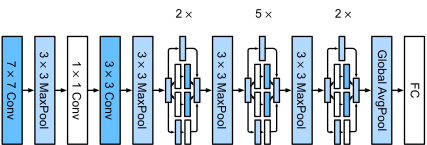
The GoogLeNet architecture.
We can now implement GoogLeNet piece by piece. Let's begin with the stem. The first module uses a 64-channel
function b1(channel_in = 1)
        Chain(
        Conv((7,7), channel_in => 64, pad = 3, stride = 2),
        MaxPool((3,3), stride = 2, pad = 1),
    )
end
b1 (generic function with 2 methods)The second module uses two convolutional layers: first, a 64-channel
function b2(channel_in = 64)
    Chain(
        Conv((1,1), channel_in => 64, relu),
        Conv((3,3), 64 => 192, relu),
        MaxPool((3,3), pad = 1, stride = 2)

    )
end
b2 (generic function with 2 methods)The third module connects two complete Inception blocks in series. The number of output channels of the first Inception block is
The number of output channels of the second Inception block is increased to Inception block constructors.
function b3(channel_in = 192)
    Chain(
        InceptionBlock(channel_in, 64, (96, 128), (16, 32), 32),
        InceptionBlock(256, 128, (128, 192), (32, 96), 64),
        MaxPool((3,3), stride = 2, pad = 1),
    )
end
b3 (generic function with 2 methods)The fourth module is more complicated. It connects five Inception blocks in series, and they have
function b4(channel_in = 480)
    Chain(
        InceptionBlock(channel_in, 192, (96, 208), (16, 48), 64),
        InceptionBlock(512, 160, (112, 224), (24, 64), 64),
        InceptionBlock(512, 128, (128, 256), (24, 64), 64),
        InceptionBlock(512, 112, (144, 288), (32, 64), 64),
        InceptionBlock(528, 256, (160, 320), (32, 128), 128),
        MaxPool((3,3), stride = 2, pad = 1)
    )
end
b4 (generic function with 2 methods)The fifth module has two Inception blocks with
function b5(channel_in = 832)
    Chain(
        InceptionBlock(channel_in, 256, (160, 320), (32, 128), 128),
        InceptionBlock(832, 384, (192, 384), (48, 128), 128),
        GlobalMeanPool(),
        Flux.flatten,
    )
end
b5 (generic function with 2 methods)struct GoogLeNet{N} <: AbstractClassifier
net::N
end
function GoogLeNet(num_classes::Int = 10)
net = Flux.@autosize (96, 96, 1, 1) Chain(
b1(),
b2(),
b3(),
b4(),
b5(),
Dense(_ => num_classes),
softmax
)
GoogLeNet(net)
end
Flux.@layer GoogLeNet
(gn::GoogLeNet)(x) = gn.net(x)model = GoogLeNet()
model.netChain(
Chain(
Conv((7, 7), 1 => 64, pad=3, stride=2), # 3_200 parameters
MaxPool((3, 3), pad=1, stride=2),
),
Chain(
Conv((1, 1), 64 => 64, relu), # 4_160 parameters
Conv((3, 3), 64 => 192, relu), # 110_784 parameters
MaxPool((3, 3), pad=1, stride=2),
),
Chain(
InceptionBlock(
Chain(
Conv((1, 1), 192 => 64, relu), # 12_352 parameters
),
Chain(
Conv((1, 1), 192 => 96, relu), # 18_528 parameters
Conv((3, 3), 96 => 128, relu, pad=1), # 110_720 parameters
),
Chain(
Conv((1, 1), 192 => 16, relu), # 3_088 parameters
Conv((5, 5), 16 => 32, relu, pad=2), # 12_832 parameters
),
Chain(
MaxPool((3, 3), pad=1, stride=1),
Conv((1, 1), 192 => 32), # 6_176 parameters
),
),
InceptionBlock(
Chain(
Conv((1, 1), 256 => 128, relu), # 32_896 parameters
),
Chain(
Conv((1, 1), 256 => 128, relu), # 32_896 parameters
Conv((3, 3), 128 => 192, relu, pad=1), # 221_376 parameters
),
Chain(
Conv((1, 1), 256 => 32, relu), # 8_224 parameters
Conv((5, 5), 32 => 96, relu, pad=2), # 76_896 parameters
),
Chain(
MaxPool((3, 3), pad=1, stride=1),
Conv((1, 1), 256 => 64), # 16_448 parameters
),
),
MaxPool((3, 3), pad=1, stride=2),
),
Chain(
InceptionBlock(
Chain(
Conv((1, 1), 480 => 192, relu), # 92_352 parameters
),
Chain(
Conv((1, 1), 480 => 96, relu), # 46_176 parameters
Conv((3, 3), 96 => 208, relu, pad=1), # 179_920 parameters
),
Chain(
Conv((1, 1), 480 => 16, relu), # 7_696 parameters
Conv((5, 5), 16 => 48, relu, pad=2), # 19_248 parameters
),
Chain(
MaxPool((3, 3), pad=1, stride=1),
Conv((1, 1), 480 => 64), # 30_784 parameters
),
),
InceptionBlock(
Chain(
Conv((1, 1), 512 => 160, relu), # 82_080 parameters
),
Chain(
Conv((1, 1), 512 => 112, relu), # 57_456 parameters
Conv((3, 3), 112 => 224, relu, pad=1), # 226_016 parameters
),
Chain(
Conv((1, 1), 512 => 24, relu), # 12_312 parameters
Conv((5, 5), 24 => 64, relu, pad=2), # 38_464 parameters
),
Chain(
MaxPool((3, 3), pad=1, stride=1),
Conv((1, 1), 512 => 64), # 32_832 parameters
),
),
InceptionBlock(
Chain(
Conv((1, 1), 512 => 128, relu), # 65_664 parameters
),
Chain(
Conv((1, 1), 512 => 128, relu), # 65_664 parameters
Conv((3, 3), 128 => 256, relu, pad=1), # 295_168 parameters
),
Chain(
Conv((1, 1), 512 => 24, relu), # 12_312 parameters
Conv((5, 5), 24 => 64, relu, pad=2), # 38_464 parameters
),
Chain(
MaxPool((3, 3), pad=1, stride=1),
Conv((1, 1), 512 => 64), # 32_832 parameters
),
),
InceptionBlock(
Chain(
Conv((1, 1), 512 => 112, relu), # 57_456 parameters
),
Chain(
Conv((1, 1), 512 => 144, relu), # 73_872 parameters
Conv((3, 3), 144 => 288, relu, pad=1), # 373_536 parameters
),
Chain(
Conv((1, 1), 512 => 32, relu), # 16_416 parameters
Conv((5, 5), 32 => 64, relu, pad=2), # 51_264 parameters
),
Chain(
MaxPool((3, 3), pad=1, stride=1),
Conv((1, 1), 512 => 64), # 32_832 parameters
),
),
InceptionBlock(
Chain(
Conv((1, 1), 528 => 256, relu), # 135_424 parameters
),
Chain(
Conv((1, 1), 528 => 160, relu), # 84_640 parameters
Conv((3, 3), 160 => 320, relu, pad=1), # 461_120 parameters
),
Chain(
Conv((1, 1), 528 => 32, relu), # 16_928 parameters
Conv((5, 5), 32 => 128, relu, pad=2), # 102_528 parameters
),
Chain(
MaxPool((3, 3), pad=1, stride=1),
Conv((1, 1), 528 => 128), # 67_712 parameters
),
),
MaxPool((3, 3), pad=1, stride=2),
),
Chain(
InceptionBlock(
Chain(
Conv((1, 1), 832 => 256, relu), # 213_248 parameters
),
Chain(
Conv((1, 1), 832 => 160, relu), # 133_280 parameters
Conv((3, 3), 160 => 320, relu, pad=1), # 461_120 parameters
),
Chain(
Conv((1, 1), 832 => 32, relu), # 26_656 parameters
Conv((5, 5), 32 => 128, relu, pad=2), # 102_528 parameters
),
Chain(
MaxPool((3, 3), pad=1, stride=1),
Conv((1, 1), 832 => 128), # 106_624 parameters
),
),
InceptionBlock(
Chain(
Conv((1, 1), 832 => 384, relu), # 319_872 parameters
),
Chain(
Conv((1, 1), 832 => 192, relu), # 159_936 parameters
Conv((3, 3), 192 => 384, relu, pad=1), # 663_936 parameters
),
Chain(
Conv((1, 1), 832 => 48, relu), # 39_984 parameters
Conv((5, 5), 48 => 128, relu, pad=2), # 153_728 parameters
),
Chain(
MaxPool((3, 3), pad=1, stride=1),
Conv((1, 1), 832 => 128), # 106_624 parameters
),
),
GlobalMeanPool(),
Flux.flatten,
),
Dense(1024 => 10), # 10_250 parameters
NNlib.softmax,
) # Total: 116 arrays, 5_977_530 parameters, 22.814 MiB.data = d2lai.FashionMNISTData(batchsize = 128, resize = (96, 96))
opt = Descent(0.01)
trainer = Trainer(model, data, opt; max_epochs = 20, gpu = true, board_yscale = :identity)
d2lai.fit(trainer); [ Info: Train Loss: 1.9313097, Val Loss: 1.971195, Val Acc: 0.5
[ Info: Train Loss: 0.6317029, Val Loss: 0.5401543, Val Acc: 0.75
[ Info: Train Loss: 0.350438, Val Loss: 0.3720257, Val Acc: 0.8125
[ Info: Train Loss: 0.41230914, Val Loss: 0.45135814, Val Acc: 0.8125
[ Info: Train Loss: 0.48061773, Val Loss: 0.36486176, Val Acc: 0.875
[ Info: Train Loss: 0.41049662, Val Loss: 0.47697634, Val Acc: 0.8125
[ Info: Train Loss: 0.24872112, Val Loss: 0.38211867, Val Acc: 0.8125
[ Info: Train Loss: 0.4497632, Val Loss: 0.4631205, Val Acc: 0.8125
[ Info: Train Loss: 0.3283075, Val Loss: 0.43611112, Val Acc: 0.75
[ Info: Train Loss: 0.37559816, Val Loss: 0.2629991, Val Acc: 0.8125
[ Info: Train Loss: 0.27002808, Val Loss: 0.274528, Val Acc: 0.9375
[ Info: Train Loss: 0.17974333, Val Loss: 0.4215269, Val Acc: 0.75
[ Info: Train Loss: 0.31861034, Val Loss: 0.3670521, Val Acc: 0.75
[ Info: Train Loss: 0.3217962, Val Loss: 0.35750878, Val Acc: 0.75
[ Info: Train Loss: 0.18585555, Val Loss: 0.30299282, Val Acc: 0.8125
[ Info: Train Loss: 0.23938179, Val Loss: 0.16103698, Val Acc: 1.0
[ Info: Train Loss: 0.22150195, Val Loss: 0.2737314, Val Acc: 0.8125
[ Info: Train Loss: 0.13171202, Val Loss: 0.19645679, Val Acc: 1.0
[ Info: Train Loss: 0.15079072, Val Loss: 0.23048335, Val Acc: 0.875
[ Info: Train Loss: 0.2121826, Val Loss: 0.18417183, Val Acc: 0.9375Discussion
A key feature of GoogLeNet is that it is actually cheaper to compute than its predecessors while simultaneously providing improved accuracy. This marks the beginning of a much more deliberate network design that trades off the cost of evaluating a network with a reduction in errors. It also marks the beginning of experimentation at a block level with network design hyperparameters, even though it was entirely manual at the time. We will revisit this topic in :numref:sec_cnn-design when discussing strategies for network structure exploration.
Over the following sections we will encounter a number of design choices (e.g., batch normalization, residual connections, and channel grouping) that allow us to improve networks significantly. For now, you can be proud to have implemented what is arguably the first truly modern CNN.
Exercises
GoogLeNet was so successful that it went through a number of iterations, progressively improving speed and accuracy. Try to implement and run some of them. They include the following:
Add a batch normalization layer [61], as described later in :numref:
sec_batch_norm.Make adjustments to the Inception block (width, choice and order of convolutions), as described in Szegedy et al. [124].
Use label smoothing for model regularization, as described in Szegedy et al. [124].
Make further adjustments to the Inception block by adding residual connection [79], as described later in :numref:
sec_resnet.What is the minimum image size needed for GoogLeNet to work?
Can you design a variant of GoogLeNet that works on Fashion-MNIST's native resolution of
pixels? How would you need to change the stem, the body, and the head of the network, if anything at all? Compare the model parameter sizes of AlexNet, VGG, NiN, and GoogLeNet. How do the latter two network architectures significantly reduce the model parameter size?
Compare the amount of computation needed in GoogLeNet and AlexNet. How does this affect the design of an accelerator chip, e.g., in terms of memory size, memory bandwidth, cache size, the amount of computation, and the benefit of specialized operations?
1.
function InceptionBlockFactorized1(channel_in::Int, channel1::Int, channel2::Tuple, channel3::Tuple, channel4::Int, reduce = false)
    r = reduce ? 2 : 1
    net1 = Chain(
        Conv((1,1), channel_in => channel1, relu, stride = r)
    )

    net2 = Chain(
        Conv((1,1), channel_in => channel2[1], relu),
        Conv((3,3), channel2[1] => channel2[2], relu, pad = 1, stride = r)
    )

    net3 = Chain(
        Conv((1,1), channel_in => channel3[1], relu),
        Conv((3,3), channel3[1] => channel3[2], relu, pad = 1, stride = 1),
        Conv((3,3), channel3[2] => channel3[3], relu, pad = 1, stride = r)
    )

    net4 = Chain(
        MaxPool((3,3), pad = 1, stride = r),
        Conv((1,1), channel_in => channel4)
    )
    InceptionBlock(net1, net2, net3, net4)
end

function InceptionBlockFactorized2(channel_in::Int, channel1::Int, channel2::Tuple, channel3::Tuple, channel4::Int, reduce = false)
    r = reduce ? 2 : 1
    net1 = Chain(
        Conv((1,1), channel_in => channel1, relu, stride = r)
    )

    net2 = Chain(
        Conv((1,1), channel_in => channel2[1], relu),
        Conv((1,7), channel2[1] => channel2[1], relu, pad = (0,3), stride = 1),
        Conv((7,1), channel2[1] => channel2[2], relu, pad = (3,0), stride = r),
    )

    net3 = Chain(
        Conv((1,7), channel_in => channel3[1], relu, pad = (0,3), stride = 1),
        Conv((7,1), channel3[1] => channel3[2], relu, pad = (3,0), stride = 1),
        Conv((1,7), channel3[2] => channel3[3], relu, pad = (0,3), stride = 1),
        Conv((7,1), channel3[3] => channel3[4], relu, pad = (3,0), stride = r),
    )

    net4 = Chain(
        MaxPool((3,3), pad = 1, stride = r),
        Conv((1,1), channel_in => channel4)
    )
    InceptionBlock(net1, net2, net3, net4)
end

function InceptionBlockFactorized3(channel_in::Int, channel1::Int, channel2::Tuple, channel3::Tuple, channel4::Int, reduce = false)
    r = reduce ? 2 : 1

    net1 = Chain(
        Conv((1,1), channel_in => channel1, relu, stride = r)
    )

    net2 = Chain(
        Conv((1,1), channel_in => channel2[1], relu),
        Conv((3,3), channel2[1] => channel2[2], relu, pad = 1, stride = 1),
        Parallel(
            (x,y)->cat(x,y, dims = 3),
            Conv((1, 3), channel2[2] => channel2[3], relu, pad = (0, 1), stride = r),
            Conv((3, 1), channel2[2] => channel2[3], relu, pad = (1, 0), stride = r)
        )
    )

    net3 = Chain(
        Conv((1,1), channel_in => channel3[2], relu),
        Parallel(
            (x,y)->cat(x,y, dims = 3),
            Conv((1, 3), channel3[2] => channel3[3], relu, pad = (0, 1), stride = r),
            Conv((3, 1), channel3[2] => channel3[3], relu, pad = (1, 0), stride = r)
        )
    )

    net4 = Chain(
        MaxPool((3,3), pad = 1, stride = r),
        Conv((1,1), channel_in => channel4)
    )
    InceptionBlock(net1, net2, net3, net4)
end
InceptionBlockFactorized3 (generic function with 3 methods)struct GoogLeNetFactorized{N} <: AbstractClassifier
net::N
end
function GoogLeNetFactorized(num_classes::Int = 10)
net = Flux.@autosize (150, 150, 1, 1) Chain(
Conv((3,3), 1 => 16, stride = 2),
Conv((3,3), 16 => 16, stride = 1),
Conv((3,3), 16 => 32, stride = 1, pad =1 ),
MaxPool((3,3), stride = 2),
Conv((3,3), 32 => 40, stride = 1),
Conv((3,3), 40 => 96, stride = 2),
Conv((3,3), 96 => 144, stride = 1),
InceptionBlockFactorized1(144, 64, (16, 64), (16, 64, 96), 64),
InceptionBlockFactorized1(288, 64, (16, 64), (16, 64, 96), 64),
InceptionBlockFactorized1(288, 64, (16, 64), (16, 64, 96), 64, true),
InceptionBlockFactorized2(288, 128, (64, 128), (64, 96, 128, 256), 128),
InceptionBlockFactorized2(640, 128, (64, 128), (64, 96, 128, 256), 128),
InceptionBlockFactorized2(640, 128, (64, 128), (64, 96, 128, 256), 128),
InceptionBlockFactorized2(640, 128, (64, 128), (64, 96, 128, 256), 128),
InceptionBlockFactorized2(640, 128, (64, 128), (64, 96, 128, 256), 128, true),
InceptionBlockFactorized3(640, 128, (64, 128, 144), (64, 128, 144), 64),
InceptionBlockFactorized3(768, 128, (64, 144, 256), (64, 128, 256), 256, true),
GlobalMeanPool(),
Flux.flatten,
Dense(_ => num_classes),
softmax
)
GoogLeNetFactorized(net)
end
Flux.@layer GoogLeNetFactorized
(glf::GoogLeNetFactorized)(x) = glf.net(x)model = GoogLeNetFactorized()
model.netChain(
Conv((3, 3), 1 => 16, stride=2), # 160 parameters
Conv((3, 3), 16 => 16), # 2_320 parameters
Conv((3, 3), 16 => 32, pad=1), # 4_640 parameters
MaxPool((3, 3), stride=2),
Conv((3, 3), 32 => 40), # 11_560 parameters
Conv((3, 3), 40 => 96, stride=2), # 34_656 parameters
Conv((3, 3), 96 => 144), # 124_560 parameters
InceptionBlock(
Chain(
Conv((1, 1), 144 => 64, relu), # 9_280 parameters
),
Chain(
Conv((1, 1), 144 => 16, relu), # 2_320 parameters
Conv((3, 3), 16 => 64, relu, pad=1), # 9_280 parameters
),
Chain(
Conv((1, 1), 144 => 16, relu), # 2_320 parameters
Conv((3, 3), 16 => 64, relu, pad=1), # 9_280 parameters
Conv((3, 3), 64 => 96, relu, pad=1), # 55_392 parameters
),
Chain(
MaxPool((3, 3), pad=1, stride=1),
Conv((1, 1), 144 => 64), # 9_280 parameters
),
),
InceptionBlock(
Chain(
Conv((1, 1), 288 => 64, relu), # 18_496 parameters
),
Chain(
Conv((1, 1), 288 => 16, relu), # 4_624 parameters
Conv((3, 3), 16 => 64, relu, pad=1), # 9_280 parameters
),
Chain(
Conv((1, 1), 288 => 16, relu), # 4_624 parameters
Conv((3, 3), 16 => 64, relu, pad=1), # 9_280 parameters
Conv((3, 3), 64 => 96, relu, pad=1), # 55_392 parameters
),
Chain(
MaxPool((3, 3), pad=1, stride=1),
Conv((1, 1), 288 => 64), # 18_496 parameters
),
),
InceptionBlock(
Chain(
Conv((1, 1), 288 => 64, relu, stride=2), # 18_496 parameters
),
Chain(
Conv((1, 1), 288 => 16, relu), # 4_624 parameters
Conv((3, 3), 16 => 64, relu, pad=1, stride=2), # 9_280 parameters
),
Chain(
Conv((1, 1), 288 => 16, relu), # 4_624 parameters
Conv((3, 3), 16 => 64, relu, pad=1), # 9_280 parameters
Conv((3, 3), 64 => 96, relu, pad=1, stride=2), # 55_392 parameters
),
Chain(
MaxPool((3, 3), pad=1, stride=2),
Conv((1, 1), 288 => 64), # 18_496 parameters
),
),
InceptionBlock(
Chain(
Conv((1, 1), 288 => 128, relu), # 36_992 parameters
),
Chain(
Conv((1, 1), 288 => 64, relu), # 18_496 parameters
Conv((1, 7), 64 => 64, relu, pad=(0, 3)), # 28_736 parameters
Conv((7, 1), 64 => 128, relu, pad=(3, 0)), # 57_472 parameters
),
Chain(
Conv((1, 7), 288 => 64, relu, pad=(0, 3)), # 129_088 parameters
Conv((7, 1), 64 => 96, relu, pad=(3, 0)), # 43_104 parameters
Conv((1, 7), 96 => 128, relu, pad=(0, 3)), # 86_144 parameters
Conv((7, 1), 128 => 256, relu, pad=(3, 0)), # 229_632 parameters
),
Chain(
MaxPool((3, 3), pad=1, stride=1),
Conv((1, 1), 288 => 128), # 36_992 parameters
),
),
InceptionBlock(
Chain(
Conv((1, 1), 640 => 128, relu), # 82_048 parameters
),
Chain(
Conv((1, 1), 640 => 64, relu), # 41_024 parameters
Conv((1, 7), 64 => 64, relu, pad=(0, 3)), # 28_736 parameters
Conv((7, 1), 64 => 128, relu, pad=(3, 0)), # 57_472 parameters
),
Chain(
Conv((1, 7), 640 => 64, relu, pad=(0, 3)), # 286_784 parameters
Conv((7, 1), 64 => 96, relu, pad=(3, 0)), # 43_104 parameters
Conv((1, 7), 96 => 128, relu, pad=(0, 3)), # 86_144 parameters
Conv((7, 1), 128 => 256, relu, pad=(3, 0)), # 229_632 parameters
),
Chain(
MaxPool((3, 3), pad=1, stride=1),
Conv((1, 1), 640 => 128), # 82_048 parameters
),
),
InceptionBlock(
Chain(
Conv((1, 1), 640 => 128, relu), # 82_048 parameters
),
Chain(
Conv((1, 1), 640 => 64, relu), # 41_024 parameters
Conv((1, 7), 64 => 64, relu, pad=(0, 3)), # 28_736 parameters
Conv((7, 1), 64 => 128, relu, pad=(3, 0)), # 57_472 parameters
),
Chain(
Conv((1, 7), 640 => 64, relu, pad=(0, 3)), # 286_784 parameters
Conv((7, 1), 64 => 96, relu, pad=(3, 0)), # 43_104 parameters
Conv((1, 7), 96 => 128, relu, pad=(0, 3)), # 86_144 parameters
Conv((7, 1), 128 => 256, relu, pad=(3, 0)), # 229_632 parameters
),
Chain(
MaxPool((3, 3), pad=1, stride=1),
Conv((1, 1), 640 => 128), # 82_048 parameters
),
),
InceptionBlock(
Chain(
Conv((1, 1), 640 => 128, relu), # 82_048 parameters
),
Chain(
Conv((1, 1), 640 => 64, relu), # 41_024 parameters
Conv((1, 7), 64 => 64, relu, pad=(0, 3)), # 28_736 parameters
Conv((7, 1), 64 => 128, relu, pad=(3, 0)), # 57_472 parameters
),
Chain(
Conv((1, 7), 640 => 64, relu, pad=(0, 3)), # 286_784 parameters
Conv((7, 1), 64 => 96, relu, pad=(3, 0)), # 43_104 parameters
Conv((1, 7), 96 => 128, relu, pad=(0, 3)), # 86_144 parameters
Conv((7, 1), 128 => 256, relu, pad=(3, 0)), # 229_632 parameters
),
Chain(
MaxPool((3, 3), pad=1, stride=1),
Conv((1, 1), 640 => 128), # 82_048 parameters
),
),
InceptionBlock(
Chain(
Conv((1, 1), 640 => 128, relu, stride=2), # 82_048 parameters
),
Chain(
Conv((1, 1), 640 => 64, relu), # 41_024 parameters
Conv((1, 7), 64 => 64, relu, pad=(0, 3)), # 28_736 parameters
Conv((7, 1), 64 => 128, relu, pad=(3, 0), stride=2), # 57_472 parameters
),
Chain(
Conv((1, 7), 640 => 64, relu, pad=(0, 3)), # 286_784 parameters
Conv((7, 1), 64 => 96, relu, pad=(3, 0)), # 43_104 parameters
Conv((1, 7), 96 => 128, relu, pad=(0, 3)), # 86_144 parameters
Conv((7, 1), 128 => 256, relu, pad=(3, 0), stride=2), # 229_632 parameters
),
Chain(
MaxPool((3, 3), pad=1, stride=2),
Conv((1, 1), 640 => 128), # 82_048 parameters
),
),
InceptionBlock(
Chain(
Conv((1, 1), 640 => 128, relu), # 82_048 parameters
),
Chain(
Conv((1, 1), 640 => 64, relu), # 41_024 parameters
Conv((3, 3), 64 => 128, relu, pad=1), # 73_856 parameters
Parallel(
var"#53#55"(),
Conv((1, 3), 128 => 144, relu, pad=(0, 1)), # 55_440 parameters
Conv((3, 1), 128 => 144, relu, pad=(1, 0)), # 55_440 parameters
),
),
Chain(
Conv((1, 1), 640 => 128, relu), # 82_048 parameters
Parallel(
var"#54#56"(),
Conv((1, 3), 128 => 144, relu, pad=(0, 1)), # 55_440 parameters
Conv((3, 1), 128 => 144, relu, pad=(1, 0)), # 55_440 parameters
),
),
Chain(
MaxPool((3, 3), pad=1, stride=1),
Conv((1, 1), 640 => 64), # 41_024 parameters
),
),
InceptionBlock(
Chain(
Conv((1, 1), 768 => 128, relu, stride=2), # 98_432 parameters
),
Chain(
Conv((1, 1), 768 => 64, relu), # 49_216 parameters
Conv((3, 3), 64 => 144, relu, pad=1), # 83_088 parameters
Parallel(
var"#53#55"(),
Conv((1, 3), 144 => 256, relu, pad=(0, 1), stride=2), # 110_848 parameters
Conv((3, 1), 144 => 256, relu, pad=(1, 0), stride=2), # 110_848 parameters
),
),
Chain(
Conv((1, 1), 768 => 128, relu), # 98_432 parameters
Parallel(
var"#54#56"(),
Conv((1, 3), 128 => 256, relu, pad=(0, 1), stride=2), # 98_560 parameters
Conv((3, 1), 128 => 256, relu, pad=(1, 0), stride=2), # 98_560 parameters
),
),
Chain(
MaxPool((3, 3), pad=1, stride=2),
Conv((1, 1), 768 => 256), # 196_864 parameters
),
),
GlobalMeanPool(),
Flux.flatten,
Dense(1408 => 10), # 14_090 parameters
NNlib.softmax,
) # Total: 182 arrays, 6_430_754 parameters, 24.548 MiB.function d2lai.loss(model::GoogLeNetFactorized, y_pred, y)
Flux.crossentropy(y_pred, y)
end
function d2lai.get_dataloader(data::d2lai.FashionMNISTData; train = true, flatten = false)
d = train ? data.train : data.val
if flatten
Flux.DataLoader((Flux.flatten(d[1]), d[2]); batchsize = data.args.batchsize, shuffle = train)
else
labels = Flux.onehotbatch(d[2], 0:9)
labels_smooth = Flux.label_smoothing(labels, 0.01)
d_reshaped = reshape(d[1], size(d[1])[1], size(d[1])[2], 1, :)
Flux.DataLoader((d_reshaped, labels_smooth); batchsize = data.args.batchsize, shuffle = train)
end
end
using Statistics
function d2lai.accuracy(model::GoogLeNetFactorized, y_pred, y; averaged = true)
y_labels = argmax(y_pred, dims = 1)
y_labels = getindex.(y_labels , 1)
y_p = argmax(y, dims = 1)
y_p = getindex.(y_p , 1)
compare = (y_labels .== y_p)
return averaged ? Statistics.mean(compare, dims = 2)[1] : compare
enddata = d2lai.FashionMNISTData(batchsize = 128, resize = (150, 150));opt = Descent(0.05)
trainer = Trainer(model, data, opt; max_epochs = 10, gpu = true, board_yscale = :identity)
d2lai.fit(trainer); [ Info: Train Loss: 1.2599708, Val Loss: 1.0393901, Val Acc: 0.6875
[ Info: Train Loss: 0.41630396, Val Loss: 0.3696559, Val Acc: 0.875
[ Info: Train Loss: 0.3655992, Val Loss: 0.3507933, Val Acc: 0.9375
[ Info: Train Loss: 0.28544185, Val Loss: 0.25390226, Val Acc: 0.9375
[ Info: Train Loss: 0.19135235, Val Loss: 0.24655311, Val Acc: 0.9375
[ Info: Train Loss: 0.26055798, Val Loss: 0.3746107, Val Acc: 0.875
[ Info: Train Loss: 0.23221236, Val Loss: 0.31955272, Val Acc: 0.875
[ Info: Train Loss: 0.17181064, Val Loss: 0.42100507, Val Acc: 0.875
[ Info: Train Loss: 0.16388367, Val Loss: 0.39053202, Val Acc: 0.9375
[ Info: Train Loss: 0.17038195, Val Loss: 0.35706797, Val Acc: 0.93751